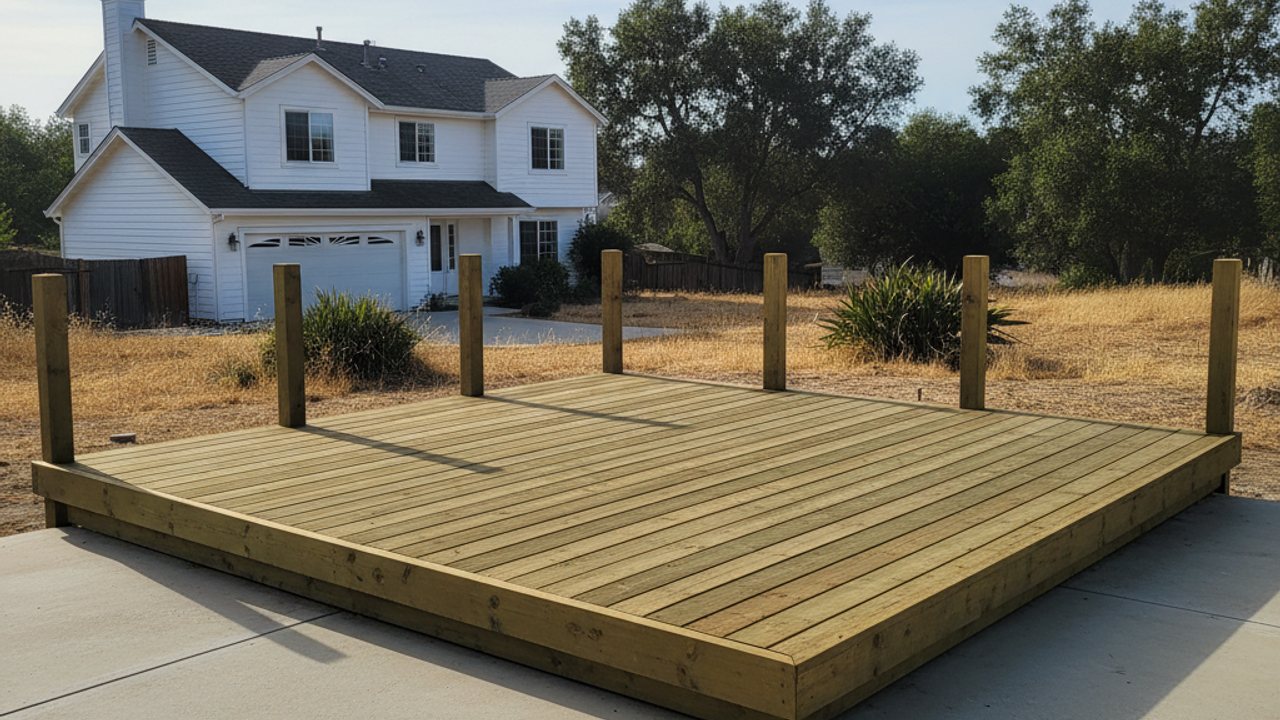
A deck is one of the few home projects where the mistakes are buried. Once the boards go down, nobody can see how deep the footings are, whether the ledger board is bolted into the rim joist or just nailed to siding, or what size post base is holding up the corner where your grandkids will stand on the Fourth of July. That's what makes picking the right builder harder than picking a painter. You're trusting someone's work you'll never inspect yourself.
Start with the permit, not the price
Any deck attached to the house and more than about 30 inches off the ground needs a permit in Turlock. If you're inside city limits, that's the City of Turlock Building Division. If you're out in the county, Ballico, Keyes, Denair, unincorporated land near Hilmar, it goes through Stanislaus County Planning and Building instead. A licensed builder should know which one applies to your address without you telling them.
What gets inspected matters more than the fact that a permit exists. The inspector is going to look at footing depth and spacing, the ledger board connection to the house, joist hanger sizing, and railing height and baluster spacing if the deck is over 30 inches high. A builder who says "we don't usually pull permits, it slows things down" is telling you they cut corners on the parts you can't see. Walk away from that one.
What the clay soil around here does to a deck
Turlock sits on Central Valley clay, in a lot of yards it's a heavy adobe clay that swells when it's wet and shrinks hard when it dries out in July and August. That movement is exactly what pushes a shallow, undersized footing out of level over a few years. A deck post sitting on a bag of concrete poured 8 inches down is going to heave. Footings around here generally need to go down 18 to 24 inches, below the zone where the clay does most of its swelling, and they need to bear on undisturbed soil, not fill dirt from when the lot was graded.
If your yard was part of an older subdivision near downtown or Wakefield, built in the 1950s or 60s, there's also a decent chance of old tree roots, buried irrigation lines, or a prior structure's footing still in the ground where you want to dig. A good builder digs a test hole before quoting a firm price. One who quotes over the phone without seeing the yard is guessing.
How the heat and the dry season change the build
Summers here run 95 to 105 degrees from June through September, and that heat matters for two parts of the job. First, concrete cures faster and can crack if it's poured on a 100-degree afternoon without being kept damp for the first few days, so footings poured in July need to be covered or misted, not just left to bake. Second, any stain or sealer applied on composite or wood decking needs to go on early morning or evening, not midday, or it flashes off before it soaks in and you get lap marks. Fall and winter, once the tule fog sets in around December, is actually a decent time to build here since there's little rain and almost no freeze-thaw cycle to worry about, unlike builders further north dealing with frost heave every winter.
Materials, and what they actually cost you over time
Pressure-treated pine is still the cheapest frame material and it's fine for structure, joists and beams, as long as it's rated for ground contact where it touches concrete or soil. For the decking surface itself, homeowners here are usually choosing between redwood, which looks good but needs re-staining every 2 to 3 years in this sun, and composite boards, which cost more up front but don't crack, splinter, or need sealing. Composite does get hot underfoot in August, some lighter colors handle that better than dark ones. Ask your builder which composite brand they install and whether it carries a manufacturer warranty separate from the builder's own labor warranty. Those are two different things and a lot of homeowners assume they're the same.
Repair versus rebuild
Not every problem deck needs to come out. If the posts and footings are sound and it's just the decking boards that are cupped, splintered, or gray, board replacement is a fraction of the cost of demolition and a new build. But if the ledger board shows rot, or the joists flex more than they should when you walk across them, that's structural, and patching over it is how decks eventually fail. A builder should be willing to tell you "you don't need a full rebuild" even when a rebuild pays them more. If every deck they look at needs to be torn out completely, that's worth questioning.
Red flags worth walking away from
- No license number offered without you asking, or one that doesn't check out with the state contractor's board.
- A bid that lists a total price but no footing depth, no post size, no board spacing, nothing you could hand to an inspector.
- Asking for full payment up front, before materials are even ordered.
- No mention of a permit at all, especially for anything over 30 inches high or attached to the house.
- Vague answers about how the ledger board attaches to your house. This is the single most common point of deck failure, and any real builder can explain it in one sentence: through-bolted or lag-screwed into the rim joist, with flashing above it to keep water out.
If a builder can walk your yard, tell you what the soil is doing, explain footing depth without checking a phone, and hand you a bid that reads like a spec sheet instead of a guess, you're probably in good hands. That's the standard we hold our own bids to at Charis Deck Solutions, whether it's a full new build, a repair, or just getting an old deck ready for another ten summers.